


iconic-pillars-of-crea-1

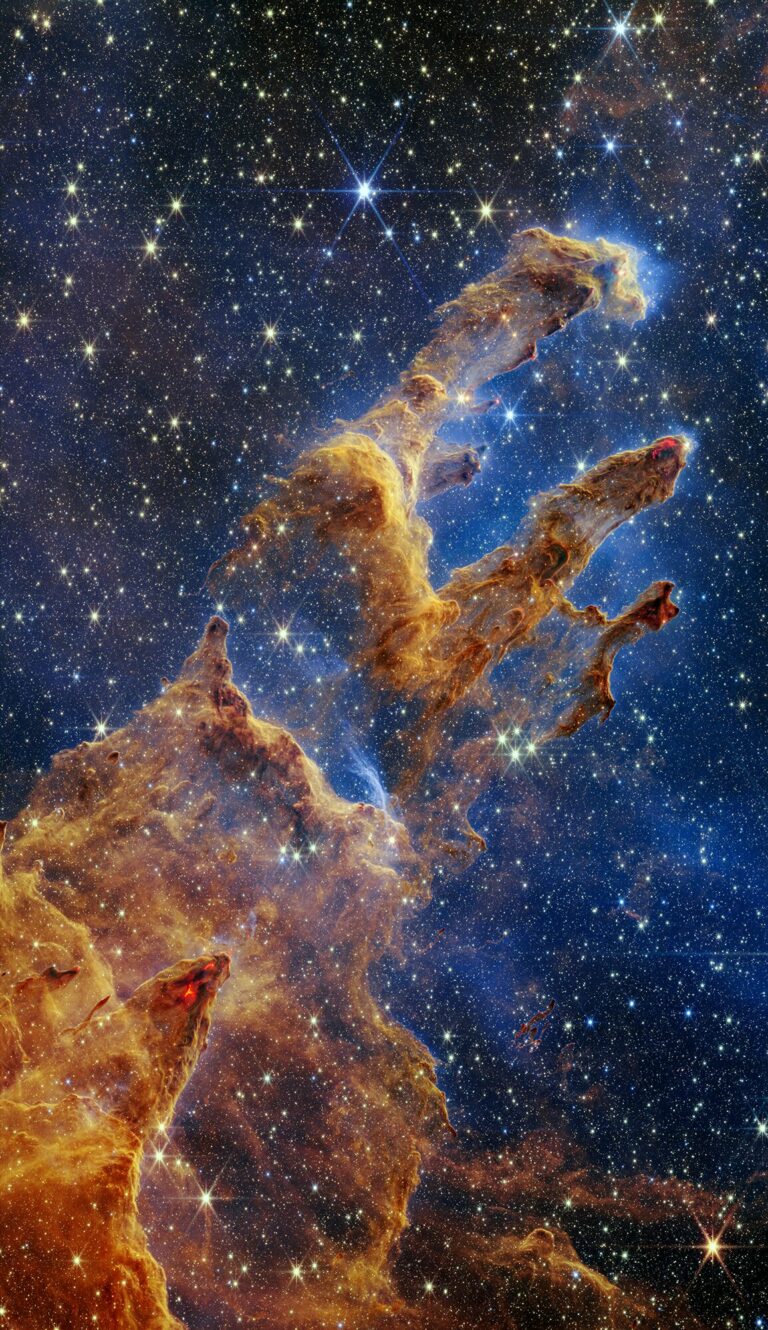
The renowned “Pillars of Creation,” vast structures composed of gas and dust teeming with stars, have been captured by the James Webb Space Telescope, as announced by NASA on Wednesday. The resulting image is truly awe-inspiring, showcasing the colossal golden, copper, and brown columns amidst the vastness of the cosmos.
Within these pillars, one can observe the shimmering radiance of numerous stars, illuminating the telescope’s inaugural photograph. At the extremities of several columns, there are vibrant red spots resembling molten lava. NASA explained that these are emissions from stars that are still in the process of formation, merely a few hundred thousand years old, as stated in their official statement.
The US space agency further elaborated that these “young stars periodically emit supersonic jets, which collide with clouds of material, much like these dense pillars.” Situated 6,500 light years away from Earth, within the Eagle Nebula of our Milky Way galaxy, the “Pillars of Creation” gained prominence through the Hubble Space Telescope, which initially captured them in 1995 and again in 2014.
However, thanks to the infrared capabilities of the Webb telescope, which was launched into space less than a year ago, it can penetrate the opacity of these pillars, unveiling the formation of numerous new stars. Klaus Pontoppidan, the science program manager at the Space Telescope Science Institute, expressed on Twitter that the decision to capture the “Pillars of Creation” with Webb was driven by popular demand.