


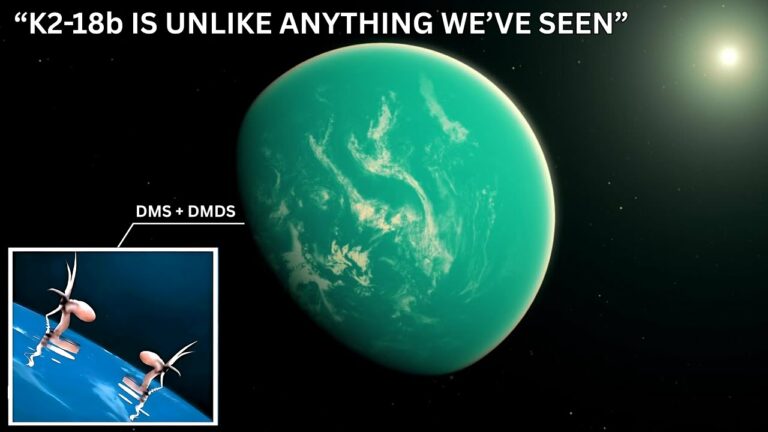


Astronomers Say They Have Found the Strongest Signs of Life on K2-18b, 120 Light-Years from Earth
Two years ago, the James Webb Space Telescope (JWST) made a groundbreaking discovery: the detection of methane and carbon dioxide in the atmosphere of exoplanet K2-18b. These carbon-bearing molecules hinted at the planet’s potential to harbor life, sparking significant interest in the scientific community.
Now, in 2025, JWST has provided even more compelling data. Scientists have identified chemical signatures of dimethyl sulfide (DMS) and dimethyl disulfide (DMDS) in K2-18b’s atmosphere. On Earth, these gases are predominantly produced by marine microorganisms, making them strong candidates as biosignatures.
The presence of these compounds suggests that K2-18b, a “Hycean” world with a hydrogen-rich atmosphere and potential global oceans, could be teeming with life.
However, while these findings are exciting, they do not confirm the existence of extraterrestrial life. The detection of DMS and DMDS, although statistically significant, requires further validation to rule out non-biological sources.
Some scientists urge caution, emphasizing the need for additional observations and theoretical studies to confirm these results.
Do not forget to share your opinion with us to provide you with the best posts !



0 Comments